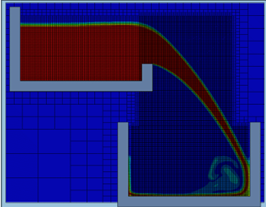
Free surface flow occurs when a fluid interacts with an open boundary, such as water crashing on a beach or sloshing in a moving container. It typically occurs at the interface between immiscible fluids (liquids and air) and proves a challenge to properly account for in your designs.
SOLIDWORKS Flow Simulation allows us to simulate these scenarios, capturing the dynamic interplay between fluids that are completely insoluble in each other.
How SOLIDWORKS Flow Simulation Handles Free Surface Flow
SOLIDWORKS Flow Simulation uses the Volume of Fluid technique to model the free surfaces. With this technique, we track fluid volume fraction between values of zero and one. In a two-phase system, the volume fraction of fluid would be one while the gas would be zero.
 The volume fraction of two fluids
The location of the free surface would be where the fluid volume fraction changes from zero to one. To evaluate this, the SOLIDWORKS Flow Simulation solver solves a single set of momentum equations and tracks the volume fraction of each of the immiscible fluids throughout the computational domain.
Considerations for Non-Newtonian Fluids
Free surface flow can also be modeled with non-Newtonian fluids such as oil, slurry, or ketchup. Non-Newtonian fluids are modeled on the assumption that the flow’s shear stress is a function of shear rate. For example, the viscosity changes with temperature, concentration, or shear stress.
The allowed combinations of fluids for free surface simulation are:
- One gas and one liquid
- One Newtonian fluid and one non-Newtonian fluid
An Example of Simulating Free Surface Flow
Free surface flow can be illustrated using a combination of olive oil and water. They can be introduced into a container from two different openings and then flow out through a common outlet port.
Study Setup
In the example, the inlet mass flow rates for each fluid are set to 0.0001 kg/s with gravity enabled on the study. Additionally, we must define goals for the volume and mass fraction of both fluids, along with a global mass flow rate. Doing so will allow us to calculate the total mixing and overall flow rates of the system.
Mesh Considerations
For simulation studies using the free surface feature, it is important to have a fine mesh. The mesh should be refined well enough to capture the interface between the two immiscible fluids.

Varying levels of mesh refinement in a flow study
One way to determine whether the mesh is fine enough is to define goals to measure the mass of each fluid and ensure conservation of mass for each fluid used in the free surface project. A few iterations of the project can be run, refining the mesh in each iteration until the mass conservation is satisfied within an acceptable tolerance.
Results
In this example, there is some numerical diffusion resulting in a lack of a crisp or sharp boundary between the oil and water. This usually happens when the simulation period is too long, and the plot appears to show mixing. This is interpreted as numerical foam at the location of the free surface.

Result plot for the volume fraction of water
What Can’t Be Simulated with Free Surface Simulation
While SOLIDWORKS Flow Simulation is a great tool for fluid studies in your designs, there are a few applications where you need to reconsider your approach for accurately modeling free surface flow.
- No phase change is accounted for
- No surface tension is accounted for
- High velocity applications are not recommended for the free surface calculations

Free surface flow simulation of water sloshing in a tank
Other Applications of Free Surface Flow
The recommended applications for free surface studies in SOLIDWORKS Flow Simulation include:
- Fluid sloshing in a tank
- Tank emptying or filling
- Drag on ships or other large vessels
- Overflowing of dams
- Low surface tension fluid studies
- Continuous jets of fluids
To learn more about SOLIDWORKS Flow Simulation, click here.
PakarPBN
A Private Blog Network (PBN) is a collection of websites that are controlled by a single individual or organization and used primarily to build backlinks to a “money site” in order to influence its ranking in search engines such as Google. The core idea behind a PBN is based on the importance of backlinks in Google’s ranking algorithm. Since Google views backlinks as signals of authority and trust, some website owners attempt to artificially create these signals through a controlled network of sites.
In a typical PBN setup, the owner acquires expired or aged domains that already have existing authority, backlinks, and history. These domains are rebuilt with new content and hosted separately, often using different IP addresses, hosting providers, themes, and ownership details to make them appear unrelated. Within the content published on these sites, links are strategically placed that point to the main website the owner wants to rank higher. By doing this, the owner attempts to pass link equity (also known as “link juice”) from the PBN sites to the target website.
The purpose of a PBN is to give the impression that the target website is naturally earning links from multiple independent sources. If done effectively, this can temporarily improve keyword rankings, increase organic visibility, and drive more traffic from search results.
